Marty Levine
May 4, 2026
I often end my writing with a call to action — a request to my readers that they do more than yell, scream, or get depressed in these troubled political times.
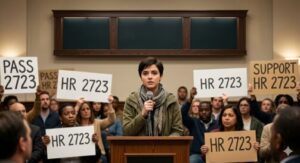
Last week I had an opportunity to personally do just that. I was asked to be a witness for the Illinois House of Representatives International Relations, Tourism, and Trade Committee subject matter hearing. (A subject matter hearing is designed to educate legislators about an issue in preparation for them calling a bill forward for a vote.)The hearing was the most recent step forward in a three-year effort to repeal a law that punished blacklisted companies that chose not to do business in Israel or in the occupied territories. In those three years of work by a broad coalition of progressive and faith-based groups has built support for this action and has grown to the point that it appears possible to pass it. I was glad that we had gotten this far forward.
Testifying against the passage of this bill were representatives of Chicago’s Jewish United Fund. They told the Committee that they are the only “true” representatives of the Jewish Community that should be listened to. Their message was that boycotting Israel is bad. Repealing this bill will not really help Palestinians, and it will harm Chicago’s Jewish Community because it will make them even more vulnerable to antisemitic attacks.
Here is what I told the members of this committee last Thursday morning.
Good morning.
My name is Marty Levine.
I am a career Jewish Communal Worker. That’s what I did, full-time and more, for 50 years. 40 of those years were spent helping guide the organization that has become the Hecktman Family JCCs Chicago, growing it into the largest Jewish Community Center system in the United States.
In that role, I worked closely with the leadership of JUF Chicago and with other Jewish organizational and religious leaders. Those 40 years provided me with a unique opportunity to see the inner workings of my Jewish Community.
I am appreciative of this Committee’s allowing me the opportunity to place HB 2723, known appropriately as the Illinois Human Rights Advocacy Protective Act, in its political context and provide background on the harm done by Illinois having the current Anti-Boycott Law.
I know how Central Israel has become to so many in my Jewish Community. I learned, first-hand, that many of my professional colleagues in the work of serving our Jewish Community, many of those who lead legacy Jewish organizations, and many of the men and women I pray with weekly have struggled to accept that the Israel of their dreams is not the Israel in this reality. They struggle to see Palestinians as a people, a people who have a claim to the same land that my Jewish community claims as a homeland.
They struggle to accept that Israel is not living up to the noble words of its Declaration of Independence; it was not a land of “complete equality of social and political rights.” They struggle to see the harm that Israel does every day.
For those who claimed to speak for the Jewish Community, those I worked alongside, Israel could do no wrong. Myths became truth, of a land without a people for a people without a land, and anxieties that Israel could be a Jewish state or a Democracy, but not both, were pushed to the back of our collective consciousness.
Against this context, the Palestinian people stopped being friends and neighbors and instead were reduced to an obstacle, an existential threat to the fantastical dream of a “Jewish” Democratic State. And Palestinians and those who supported them were just threats to the status quo of an Israeli government that marginalized and brutalized an entire people.
Public consciousness grew, and from this came the push to pass a law in Illinois. The impetus for this effort was to support Israel’s increasingly aggressive efforts to destroy a Palestinian future. This we know from a now public 2018 email from Andrew Lappin, who served in leadership positions for the Jewish United Fund of Metropolitan Chicago and was the first Chair of IIPB’s Israel Boycott Restrictions Committee to Jay Tcath, who is a senior JUF executive, then responsible for JUF’s Public Policy agenda. Mr. Lappin, concerned about the “loyalty” of possible new appointments to the IIPB and not understanding that their job was “protecting Israeli Sovereignty, and as regards Judea and Samaria, appreciating that would result from failing to do so.”
This was not about protecting the Jewish people, this was about protecting an Israeli government and its expansionist desires at the expense of the Palestinian people.
From 2005, when the Palestinian Civil Society Representatives first issued their call for a boycott of Israel, a demand that only asked that Israel comply with International Law and the Universal Principles of Human Rights, until 2014, when the effort to combat it reached Illinois, the call for Boycotting Israel became louder and louder.
Boycott, Divestment and Sanctions (BDS), by its very nature, a non-violent, political strategy, was seen by those who saw any protest of Israeli policy or action as an existential threat to the status quo. It was seen as so much of a threat that the Israeli Government began to spend money to combat it (an amount that has today grown to $730 million), and Illinois became Ground Zero for legislative maneuvers to construct legal hurdles to effectively attempt to have it blackballed, outlawed, and to boycott BDS.
The potential of a mass movement, a peaceful mass movement, standing up and saying Israel is an oppressor, was a threat to the status quo of Israel. It was a threat because it is non-violent. It is a threat because it relates Palestine to other oppressed people. It is a threat because it calls for equality. It is a threat because it does not demonize the cause of the Palestinian people.
BDS was particularly scary to those who saw their purpose as protecting Israel, no matter what. Non-violent protest for the rights of the oppressed had great resonance in our country.
We remember that in 1955, Rosa Parks refused to give up her seat on a segregated bus and launched a 13-month boycott of the buses in Montgomery, Alabama, to protest the white racist oppression of African Americans. This was one of the beginning steps that pushed this country to redress our wrongs…work that is still not done. This was a movement that many of us were called to support.
We remember that in 1959, an international movement began calling for a boycott of South Africa to end apartheid, which, after years of struggle, proved to be successful. Again, an effort to overturn an oppressive regime that resonated deeply for many of us.
And let’s be clear, since 2014, things have only gotten worse. Israel has become clearer about its desire to crush the will of the Palestinian people and forever divorce them from their land, and destroy the Palestinians’ hopes and dreams. The brutality of the occupation has become unavoidable.
By 2021, things had gotten so bad that one of Israel’s most respected civil rights groups, B’Tzelem, published a report telling the world that “all Palestinians living under Israeli rule are treated as inferior in rights and status to Jews who live in the very same area.” This, they said, was Apartheid.
The same year, Human Rights Watch reached a similar conclusion.
In 2024, the International Criminal Court issued indictments of Israeli Government Leaders for war crimes.
Just days ago, the world-renowned Israeli Holocaust scholar Omer Bartov, who recognized that Israel was committing war crimes and acts of ethnic cleansing in Gaza, made this statement in an interview published in the English-language edition of the Israeli newspaper Haaretz:
…Zionism as an ideology didn’t just run its course. It became something I don’t recognize. It became the ideology of the state. And it became not only militaristic and expansionist but also racist, extremely violent, and ultimately an ideology that deeply harms both the individual and the collective. Such an ideology has no place.
And earlier this week, Tamir Pardo, the former chief of Israel’s powerful Mossad intelligence agency, said that what he witnessed during a tour of the Occupied West Bank reminded him of the treatment of the Jewish people during the Holocaust by Nazi Germany in the 1930s and 40s.
Things have now gotten so bad that words written in 1967 by Israeli novelist Amos Oz resonate loudly because they spoke about Israelis and Jews:
We were not born to be a people of masters. “To be a free people” — this wish must awaken an echo in our hearts so long as we have not lost our humanity. We are condemned now to rule people who do not want to be ruled by us…an occupation is inevitably a corrupting occupation, and even a “liberal and humane” occupation is an occupation I have fears about the kind of seeds we will sow in the near future in the hearts of the occupied. Even more, I have fears about the seeds that will be implanted in the hearts of the occupiers.
I see no validity in the annexation of populated regions to the bounds of the State of Israel without the agreement of their inhabitants. The residents of Nablus and Gaza are not “human material”, nor “human dust”, nor “sub-human rabble who have to be expropriated so as to create living space”.
And that leads us to what we are talking about this morning.
Keeping the status quo means keeping the interests of the almost 900,000 Illinoisans who are counting on their pensions in the hands of a Board formed for this political interest, and which has no fiduciary responsibility.
Keeping the status quo says, In the face of oppression, Illinois will punish those who non-violently wish to protest against Israel. The evidence is clear. Ben and Jerry’s, a company that built its success as a values-driven business from its inception, had to be punished when it pulled its products out of the Occupied West Bank, explaining that
We’re a values-led company with a long history of advocating for human rights and economic and social justice. We believe it is inconsistent with our values for our product to be present within an internationally recognized illegal occupation.
Keeping the status quo continues to lead Illinois down a path of punishing protected speech and non-violent protest, and parallels what President Trump did this week when he punished Green Card holders for speech he disagreed with.
Those telling you that the law should stay in place want to depict BDS as something other than non-violent. They say or hint that it is anti-Semitic. They say or hint that it will lead to violence. What they don’t say is what Andy Lappin said years ago — that the purpose of this law is to support Israeli policy, no more, no less.
When it is impossible to protest peacefully, what is left?
My brethren in the Warsaw Ghetto recognized this; Nelson Mandela recognized this; Martin Luther King, Jr. recognized this.
We all must recognize this and not make it harder for those who see inequity and raise their voices in protest, in peaceful protest.
You do not need to agree with them to protect their right to protest peacefully.
It is never too late to correct a mistake. In 2026, Illinois can and must act to erase this dangerous law from the books.
The bill will be called for a vote in the next few weeks.