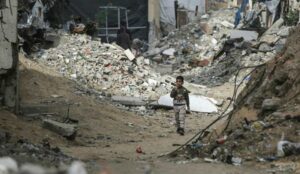
| Further on in their feed, they ran a story about life after the ceasefire was announced months ago, headlined ‘It Never Ended’: As the World Moves On, For Gazans It’s War as Usual. In the story, they highlighted what life was like from the perspective of several Gazans including 22 year old Mohammed Sami, who
returned to Jabalya immediately after the cease-fire was announced, after spending just over a month displaced in Deir al-Balah. He hoped the announcement would mean he could finally resume his studies in accounting, which had been interrupted for months by the war, which led to near-total internet outages. Instead, he says, what awaited him was devastation.
Jabalya, he explained, no longer functions as a city. Water and electricity are largely unavailable, markets have disappeared, and roads have been rendered unusable after months of bombardment. Israeli forces, he says, raid the area repeatedly, placing concrete barriers along the Yellow Line and firing shells and dropping bombs that keep residents in constant fear.
“The occupation forces move inside the city every night,” Sami says, describing incursions from the east, north, and west around midnight. Above them, quadcopters hover, emitting what he calls “terrifying noises,” a form of intimidation residents have grown accustomed to. With most families now living in makeshift tents, there are no meaningful protective measures.
The New York Times reported that a day later that “Israel Is Still Demolishing Gaza, Building by Building.”
Israel has demolished more than 2,500 buildings in Gaza since the cease-fire began, according to a New York Times analysis of satellite imagery from Planet Labs. It says it is destroying tunnels and booby-trapped homes.
Most of the demolitions since the cease-fire began have been in those Israeli-controlled areas.
But dozens of buildings have been destroyed beyond the yellow line in areas effectively under Hamas control, where the Israeli military had agreed to halt its operations.
Haaretz on the same day wrote about what was happening on the other side of 1948 Israel on the West Bank: ‘The Situation Has Become Too Difficult’: Palestinian Villagers Leave Their West Bank Homes Over Harassment by Israeli Settlers:
Despite decades on their land, villagers describe daily threats from settlers – including stolen livestock, blocked roads, and attacks on children – forcing families to leave their community of Ras Ein al-Auja in the West Bank.
Around 20 of the 120 or so families that live in the Bedouin community of Ras Ein al-Auja, in the Jordan Valley, left their homes in the hamlet’s western part on Thursday. The move followed an escalation in the past week of the harassment by residents of nearby settlement outposts. Additional families left over the weekend.
Mahmoud Salamah Ka’abana, who left Ras Ein al-Auja with his family on Thursday, said the community’s situation was good until settlers began establishing outposts in the area about two and a half years ago.
“We used to roam freely with the flocks for long distances and water the sheep and goats at the Auja Stream,” he said, adding how the settlers began to restrict residents’ access to distant grazing lands with threats and violence. Subsequently, grazing stopped almost entirely; in addition, around 1,500 of the village’s sheep and goats were stolen from the community over a period of about two years.
Palestinians who are Israeli citizens, about 20% of the total population of Israel, face life as second-class citizens. In an interview published by Jacobin Magazine, Israel Historian Ilan Pappe described their plight.
In 2000, the Israeli political elite began to legislate against Palestinians in Israel. All kinds of unofficial practices against them suddenly became legal. For instance, Palestinians always had very limited access to land — they could not expand their areas — but now it also became illegal for them to do so. It was also forbidden for them to talk about the Nakba.
All of this culminated in the Nationality Law in 2018, which officially stated that Palestinians can be individual citizens of Israel, but they cannot be part of a national community. And this refers not only to 1948 territory — from the river to the sea, there is only one nation, the law says, and this is the Jewish nation. There is no other nation there.
The discrimination against Palestinians inside of Israel is not as dramatic as in the West Bank, not to mention what’s happening in Gaza. But compared to Jewish citizens, they are second-rate, if not third-rate, citizens. Even before the changes of law in the early 2000s, as I argue in the book, they were living in a semi-apartheid state — some even say a full apartheid state. Palestinians were discriminated against all along because of who they were and not because of what they did.
From every perspective, this is not a picture of things getting better.
If you are still not convinced, take a deep breath and watch 39 seconds of video reporting that captures an attack on a 68-year-old Palestinian worker in a Palestinian-owned nursery, a business that has been burned and repeatedly vandalized by Israeli settlers; https://twitter.com/i/status/2011844367430877192. Take a deep breath before you watch it.
Yes, there is little new in this article. I’ve told this story before, Killing and atrocities in the same places before and after October 7th. But if it is the same story, does not mean that we should stop telling it?
The power imbalance between the two sides makes it difficult to see much optimism. The horrific nature of Israel’s war on Gaza was so evident that there was a growing force of international pressure that made hoping for a better outcome possible, even as the daily news shocked my senses. But since the ceasefire, that pressure has waned, and Israel appears to again think it can do as it wishes. And it is.
Without a major effort to change the balance, the situation will continue to fester until we are “shocked” again by the next moment, like October 7. And that itself is a sign about how little the world values Palestinian lives.
I hope I am wrong in my pessimism, but I see little right now to tell me that I am.
And, if I must, I will keep asking my readers not to look the other way. |