
Marty Levine
June 3, 2026
Late Sunday night (technically it was actually well into Monday morning), the Illinois Legislature approved a state budget for the coming year. Illinois, my home state, faces, as do many states, a challenge in meeting its responsibilities to its residents. With costs rising, states must also adjust to the Trump Administration’s cuts to national safety net programs. Because Illinois is a very Blue state, the budget must also protect against the vindictiveness of the MAGA regime. This means either reducing costs, which means further weakening our social safety net and hurting those already the most vulnerable in our society, or raising new revenue, which means raising taxes. Uniquely, the state’s constitution requires its budget to be balanced; unlike the Federal Government, it cannot budget a deficit and close a budget gap with a loan.
For years, progressive voices have pointed out that in Illinois, the tax system is regressive. Because it relies heavily on sales taxes, property taxes, and user fees, poor people pay a larger percentage of their income in taxes than do those who are wealthier. And this is particularly bad in Illinois because it is locked into a flat income tax; it cannot, as the Federal Tax system does, require those with higher income to pay a greater rate.
In 2020, the voters of Illinois had a chance to change that and allow the State to create a graduated income tax. While over 55% voted to approve a constitutional amendment, a 60% margin was needed, and the effort failed.
The impact of this is serious. More state revenue may be needed but finding progressive ways to accomplish that is challenging. The legislature was given four options for finding increased state revenue in a progressive way by a team of organizations operating under the banner of the Illinois Revenue Alliance. The Alliance proposed four new ways to raise funds that would impact the wealthiest rather than the poorest.
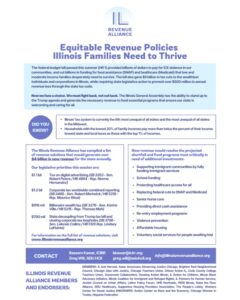
It is important to note that only one of these, the wealth tax, directly focused on those who control so much of our nation’s riches. But when the budget was passed last night, the only new tax on digital advertising was included. The rest, over $3 billion, was left on the table.
Again, it proved too hard to generate support for progressive taxation even in a Blue State and from a legislature that has a super majority of Democratic legislators.
It is not that we are not aware that wealth is being concentrated in a smaller and smaller slice of the population. Almost every day we can read about another instance of how wealth is being hoarded and concentrated in the wallets and bank accounts of just a few men and women.
From the New York Times on May 29th:
A year ago, the Trump administration withdrew from a global effort to curb offshore tax-dodging by multinational companies. That decision has been a huge gift to corporate America, enabling companies to avoid at least $40 billion in income taxes since the beginning of 2025.
A New York Times review of securities filings from nearly 500 companies showed that they avoided taxes by attributing hundreds of billions of dollars in earnings to low- or no-tax foreign locales like Cyprus, Bermuda, Switzerland and the Cayman Islands. Often, corporations funneled the profits through subsidiaries in places where they had no employees, offices or customers.
Tax havens became more appealing after President Trump signed an order on his first day back in office withdrawing the United States from a 13-year international effort to end such schemes. The effort led dozens of countries to impose a minimum corporate tax and rules for pursuing companies using tax havens. After House Republicans passed legislation last year targeting some of those countries with a new tax, international officials agreed to exempt U.S. companies from much of the crackdown.
From Nobel Prize winning economist Paul Krugman’s Substack on May 31st :
…there’s a growing public sense that the system is unfair and rigged against ordinary people. This sense partly reflects the reality that a rising share of economic rewards is going to shareholders as profits rather than to workers as earned income. It also reflects the fact that, even as a growing share of income accrues to wealth, within the growing upwards distribution of income within, there is growing concentration of wealth at the very top. In other words, a rising share of unearned total income is going to a very small number of people.
As a result, it is now widely recognized that the U.S. economy is far more unequal than it was a few decades ago.
Crucially, soaring profits overwhelmingly benefit a small fraction of the population. Many Americans have a small stake in the stock market because of 401(k)s and other retirement plans, but even including those plans the great bulk of stocks are held by the richest 10 percent of the population, with half of stocks owned by the richest 1 percent and almost half of that held by just 0.1 percent of the population.
Despite it being very clear that we are at a stage of economic inequality that our nation has never seen before, we seem at any level of government unable to change the government structures that are the foundation of inequality. We struggle to create a fair tax system.
If you are struggling to accept how unfair our tax system is try reading this NY Times interview with Professor Ray Madoff. Here’s a small snippet to whet your appetite.
So, the Mars, the Kochs, the Waltons — they all got together, and they were like: OK, we’ve got the income tax handled. We can borrow, we can avoid salaries. But this estate tax — Congress keeps fixing it. They keep doing the generation-skipping transfer tax, they do the special-valuation rules. We have to stop them.
They funded this campaign to turn the public against the estate tax, and they did so by telling the public that the estate tax was an immoral death tax — making it seem like it came for everyone. Rather than an estate tax that definitely had a rich people air to it.
They said: No, this is a death tax. It comes for all, and it particularly harms family farms and businesses.
Now, what they didn’t say was that there are actually a lot of provisions in the tax code specifically designed to protect family farms and businesses. And indeed, Congress had a very hard time finding actual examples of people who actually lost their farms.
That’s how skewed our current system is.
The wealth that is hoarded buys not only luxuries, but it also buys power. And that power has been used again and again to defeat attempts to change the system and make the playing field more level.
Until we as a body politic figure out a way to elect legislators and executives who are willing to risk the ire of the wealthiest, we will continue, as Illinois did just days ago, to struggle to not balance its budget on the backs of the neediest among us.