Marty Levine
September 2, 2026
In my hometown of Chicago, the area’s median income for an individual is $85,100; for a family of four, it is $121,500.
According to MIT’s Living Wage calculator, an individual adult needs to earn $53,667 to meet the costs of their basic needs: food, rent, childcare, health, other essentials and taxes; a family of four requires two working adults earning $90,382.
Consider the data in the chart below projecting kind of work projected to grow fastest over the coming decade
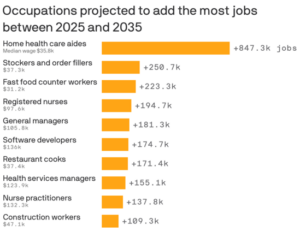
Of the projected nearly 2.5 million new jobs, almost 2/3 are in jobs below, many well below, what is needed for an individual to live a modest but lifestyle in Chicago. Sixty percent of these jobs would not require both people working full-time to bring their family of four to that modest level.
In a country that prides itself on being a place where hard work is the guaranteed road to success, this is a depressing picture. It describes an economy that continues to refuse to share the fruits of labor with its workers.
Last week the Institute for Policy Studies and Inequality.org published their 32nd annual Executive Excess Report examining “the 100 S&P 500 corporations with the lowest median worker pay.”
The Fortune 500 is a list of the largest businesses in the world. Together they employ more than 30 million workers worldwide. The IPS study focused on the 100 companies on this list with the lowest median wage, meaning that half of their employees earn less than this amount annually.
The average wage for these 100 very large corporations was only $36,571 for a full year’s work. That is not enough for either an individual or a two-working-parent family of four to live comfortably in Chicago.
And for many, a full year’s work still has them turning to government safety-net programs to get by.
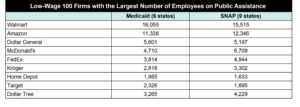
These are the symptoms of our nation’s economic and political systems that are increasingly tilted toward the wealthy and away from most of us. The projected job creation data and IPS’s look at large companies that pay their workers badly point to one part of the problem. IPS shows us that the average annual compensation of these company’s CEO’s was more than $15.7 million, more than 600 times larger than their company’s median salary. This gap has also gotten wider year by year.
And the resources that could be used to reward workers, to bring their earnings above levels that force them to rely on the national safety net or struggle to live comfortably, are diverted to those who are already wealthy. These businesses had the resources to reward their stockholders by using more than $108 billion for stock buybacks, which, because most stocks are owned by the wealthiest among us, shifts wealth from those who help generate it to those who already have it.
While 58% of American families now own stock (up from 53% in 2019)…median stock holdings for the bottom half of stockholders are $12,600 compared to $608,000 for the top decile, a 48-fold difference that means annual gains for wealthy investors…
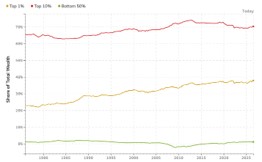
As this chart illustrates, the wealth of our nation is not close to equitably shared. For most of us, the quality of our life depends heavily on what we earn each week, each month, each year and not on our portfolios.
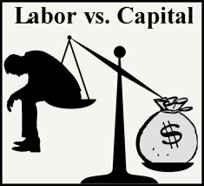
And year by year, as Nobel Prize-winning economist Paul Krugman has been recently illustrating in several recent essays he has published on Substack, the nation has increasingly favored the few who are already wealthy (Capital) at the expense of those whose efforts create it (Labor).
According to Krugman
Since 2000…the share of labor compensation in total income has declined sharply. In other words, the share of national income going to workers, including highly paid workers, has plunged while the share going to the owners of capital has soared. Furthermore, the rise of AI, which appears to reduce the need for workers while requiring huge capital investments both in software and in physical assets such as data centers, power supplies, and advanced chips, may cause a further large shift in income from labor to capital…
Billionaires now exert vast and growing influence over our politics as a result of the income and wealth they accrue from their ownership of vast amounts of capital. It’s crucial to understand that policy — both regulatory policy and tax policy — can play a key role in either reversing or exacerbating this historic shift against labor.
Paying Executives grossly large salaries and worker-bees badly is part of the problem. Allowing corporations to use their earnings to reward their shareholders through lucrative buybacks is part of the problem.
IPS’ report ends with a series of recommendations for change that focus on three areas of concern:
- Taxing extreme CEO-worker pay gaps: (for example) In one survey, a tax hike on corporations that pay their CEO over 50 or more times what they pay their median employees.
- Increasing the buybacks tax: (raising) the current excise tax on stock buybacks…to… 4 percent instead of 1 percent (would have had just these 100 businesses pay) $9.3 billion in additional federal taxes on share repurchases in the three-year period 2023-2025.
- Leveraging government contracts and subsidies: A bipartisan provision in the pending Senate defense authorization bill would bar military contractors from engaging in stock buybacks. This builds on modest Biden administration progress to use the power of the public purse to rein in CEO pay. But governments at all levels could be doing much more to leverage this power against executive excess.
Everything that IPS is recommending will help. But it is not enough.
We need to fix our overall tax code that is increasingly tilted in favor of the wealthy. And we need to change our system of administering our tax system because today it encourages the wealthy to cheat. It is so underfunded that it cannot audit the wealthy, and it is so dishonestly managed for the advantage of cheaters.
Here again I turn to Krugman
…the top federal tax bracket on individual incomes was more than 90% in the 1950s, versus 37% now. Large corporations paid a tax rate of 52% on their profits in the 1950s, which is now down to 21%. Large estates paid a 77% tax rate until 1976; now the rate is only 40%, and that only applies to the value in excess of $15 million.
However, beyond these reductions in statutory rates, tax avoidance and tax evasion have grown significantly. “Avoidance” and “evasion” may sound like synonyms, but they are not: avoidance involves exploiting loopholes in the tax code in ways that are legal, even if they shouldn’t be, while evasion involves breaking the law.
And tax evasion is now a very big concern. Reasonable estimates of the “tax gap” — taxes that individuals and businesses are legally obliged to pay, but don’t — are startlingly large — $600 billion a year or more – approximately 40% of the current budget deficit. Furthermore, much of this tax gap is surely accounted for by tax evasion by high-income Americans. So, tax evasion is a significant contributor to both the rise of American oligarchy and the high federal debt.
Efforts to revise our tax code so that it stops favoring the few who are wealthy at the expense of the vast majority who are not, have failed at the hands of the Republican Party in all its various incarnations.
And the Republican Party has consistently worked to defund the IRS and roll back its efforts to fight tax cheating.
The cost of their success can be measured in the $20 trillion national deficit. It can be measured in the rolling back of social safety net programs like Medicare and the Obamacare subsidies, just to name a few.
It can be measured in the data showing that even working hard does not make a comfortable life possible.
The battle for the reforms we desperately need will not be easy. We are living at a time when the wealthy have been allowed to use their wealth to buy political influence. They are doing this using staggering amounts of money. You know they will fight tooth and nail against reform efforts.
And we know those teeth and those nails will be the best their fortunes can buy.
We will need to match this by being brave enough to talk about the issue. Being brave enough to ask folks like me who are in the upper middle class, to understand the need to risk having to pay higher taxes themselves for the greater good. We need to find politicians at the local, state and federal level who agree with us and are willing to risk running with a platform of taxing the rich.
Only if we can do this, can this pernicious trend be reversed. Only if we do this will there be a year when IPS will no longer need to publish another edition of “Executive Excess.”